02 Jul 2026

Modern yoga has been stripped down to gymnastics and stress relief. But the authentic practice was never birthed in a quaint, candle-lit sanctuary. It was discovered through sweat, grit, dust, and raw survival.
Yoga, in its truest and most authentic form, is a borne of endurance originatiing from pilgrimage culture.
This article is a guide to that forgotten origin. It is a journey back to the rugged terrain of the Asia and the high, unforgiving peaks of the Himalayas, where the path itself forced the practice out of human beings. From the sacred verses of the Rig Veda to the living, breathing pilgrimage paths of Nepal today, you will discover that yoga is not a workout you perform, rather, it is a practice system you run to march straight through the challenges of life.
Around the 6th century BCE, a massive spiritual rebellion swept across ancient India. It was called the Śramaṇa movement—the movement of the "strivers" or "renouncers."
Before this revolution, spirituality was a transactional system borne from Puranic based Hindiusim, dominated by elite priests. If you wanted to connect with the divine, you paid a priest to perform an expensive ritual or sacrifice on your behalf.
A wave of radicals decided they were done outsourcing their liberation (Moksha). They realized that true transformation can only be experienced firsthand. So, they did something terrifying: they walked out on conventional society.
As these ascetic nomads, in search of the truth, walked thousands of miles barefoot through monsoons, thick jungles, and freezing mountain passes, their paths naturally aligned with sacred geography, places where the physical world felt "thin." These walking routes became the ancient world's network of pilgrimage (Tirtha Yatra).
Because they were constantly on the move, these wandering yogis became the human nervous system of ancient philosophy. A yogi would pick up a breathing technique in the south, walk two thousand miles north, and trade it with a Buddhist monk in a Himalayan cave. Pilgrimage was the original open-source network that carried, mixed, and popularized yoga.
As these wandering ascetics traveled between sacred rivers and mountain peaks, they would periodically converge at massive pilgrimage festivals like the ancient equivalent of the modern Kumbh Mela. Kumbh Mela is the world's largest peaceful religious gathering, where millions of Hindu pilgrims, mystics, and ascetics converge at sacred rivers to bathe, trade spiritual wisdom, and celebrate collective liberation.
These gatherings acted as raw, unfiltered spiritual conventions. Mystics, forest hermits, meditators, and wild ascetics collided around campfires. In these high-intensity environments, they traded Yogic secrets :
They shared breathwork practices to fight off freezing alpine temperatures.
They debated deep, groundbreaking philosophy.
They shared physical movements to repair joints and muscles shattered by months of relentless marching.
This cross-pollination is where the foundations of physical yoga were refined.
📌 Rethinking the Vocabulary: Asana
This historical reality gives a profound twist to the very vocabulary we use today. Consider the word Asana, which modern practitioners use to describe a yoga pose or stretch.
Historically, Asana does not mean stretch. It literally translates to "seat."
For a pilgrim or a wandering nomad who had been marching across a continent for weeks on end, the ultimate physical superpower wasn't hyper-flexibility. It was the raw stability required to finally sit down, lock the spine, be perfectly still, and quiet the chaotic noise in the head.
To find the absolute bedrock of this practice, we must look back over 3,000 years to the oldest sacred text of India: The Rig Veda.
Specifically, Rig Veda 10.136—famously known as the Keshin Hymn (the hymn of the "Long-Haired Ascetic")—gives us a direct, vivid window into a wild, pre-classical yogi who operated completely outside mainstream civilization. This text outlines the three core mechanics of true pilgrimage yoga.
The hymn describes these wandering mystics as Munis (silent sages) or Keshins (the long-haired ones):
"The Munis, girdled with the wind, wear garments soiled of yellow hue. They follow the wind's swift course..."
"Girdled with the wind" means they went completely naked or wore shredded, dust-covered rags. They endured the weather as a form of spiritual discipline, exposing their flesh directly to the elements of the road to shatter the boundaries of the ego.
The text describes a violent internal mechanism in Verse 7:
"Vayu [the Wind God] hath churned for him... when he with long loose locks hath drunk, with Rudra, water from the cup."
In later yoga systems, Vayu represents Prana (the life-force or breath). The Rig Veda describes the Wind God "churning" and "pounding" within the yogi. This is the earliest poetic description of intense Pranayama (breath control).
On a steep mountain ascent, your lungs are forced into involuntary, heavy, rhythmic gasping. By churning this inner wind to adapt to thin air, the pilgrim alters their physiology, flooding their blood with oxygen and shifting the brain into an intense state of ecstatic, hyper-focused awareness. The text records the yogis declaring: "You mortals see only our bodies, but we have mounted the winds."
The very first line of the hymn sets up the raw power of this internal practice:
"The long-haired one bears fire (Agni), the long-haired one bears poison (Visha)..."
The fire mentioned here is Tapas - the intense, internal metabolic heat generated by breathwork, starvation, and grueling physical effort. The physical exhaustion of the trail is the wood, the churned breath is the bellows, and the radiant heat generated in the chest is the divine flame.
The text notes that the yogi drinks Poison (Visha) alongside Rudra (the fierce, wild mountain god who later evolves into Shiva, the Lord of Yoga). The road was toxic, filled with bad water, freezing rains, and disease. While ordinary society hid in houses to avoid this poison, the wandering yogi used his massive internal furnace to consume the hardships of existence and transform suffering into raw, divine power.
The mainstream Vedic religion was built around external rituals (Yajnas). Priests constructed physical brick altars, lit a fire with wood, and threw clarified butter (ghee) into the flames while chanting.
The pilgrimage yogis of the Rig Veda did something revolutionary: they internalized the entire altar. This practice is known as Prana-Agni-Hotra (the fire sacrifice inside the breath).
Later philosophical texts, like the Upanishads, expanded deeply on this internal architecture. They stopped viewing the heart as a mere organ and mapped it as a cosmic sanctuary.
The Katha Upanishad: A young boy named Nachiketa journeys to the God of Death to learn the secret of immortality, and is taught the hidden nature of the internal flame:
"Know this fire to be the possession of infinite existence, the foundation of the universe, and the thing hidden in the secret cave of your being." (Katha Upanishad 1.1.14)
The Chandogya Upanishad: This text outlines the Dahara Vidya (the meditation on the small space), explaining that the heat felt in the body during heavy exertion is the radiation of an infinite internal space:
"There is this city of Brahman (the body), and in it a palace, a small lotus house (the heart); and within that a small space... What is within that small space is what should be sought after." (Chandogya Upanishad 8.1.1)
The formula across all these ancient texts is identical:
Concentrated Will (Tapas)+Churned Breath (Vayu)=The Awakening of the Heart Fire (Agni)
This ancient Rig Vedic technology is not dead history. It is an unbroken, living reality thriving right now in the pilgrimage culture of Nepal.
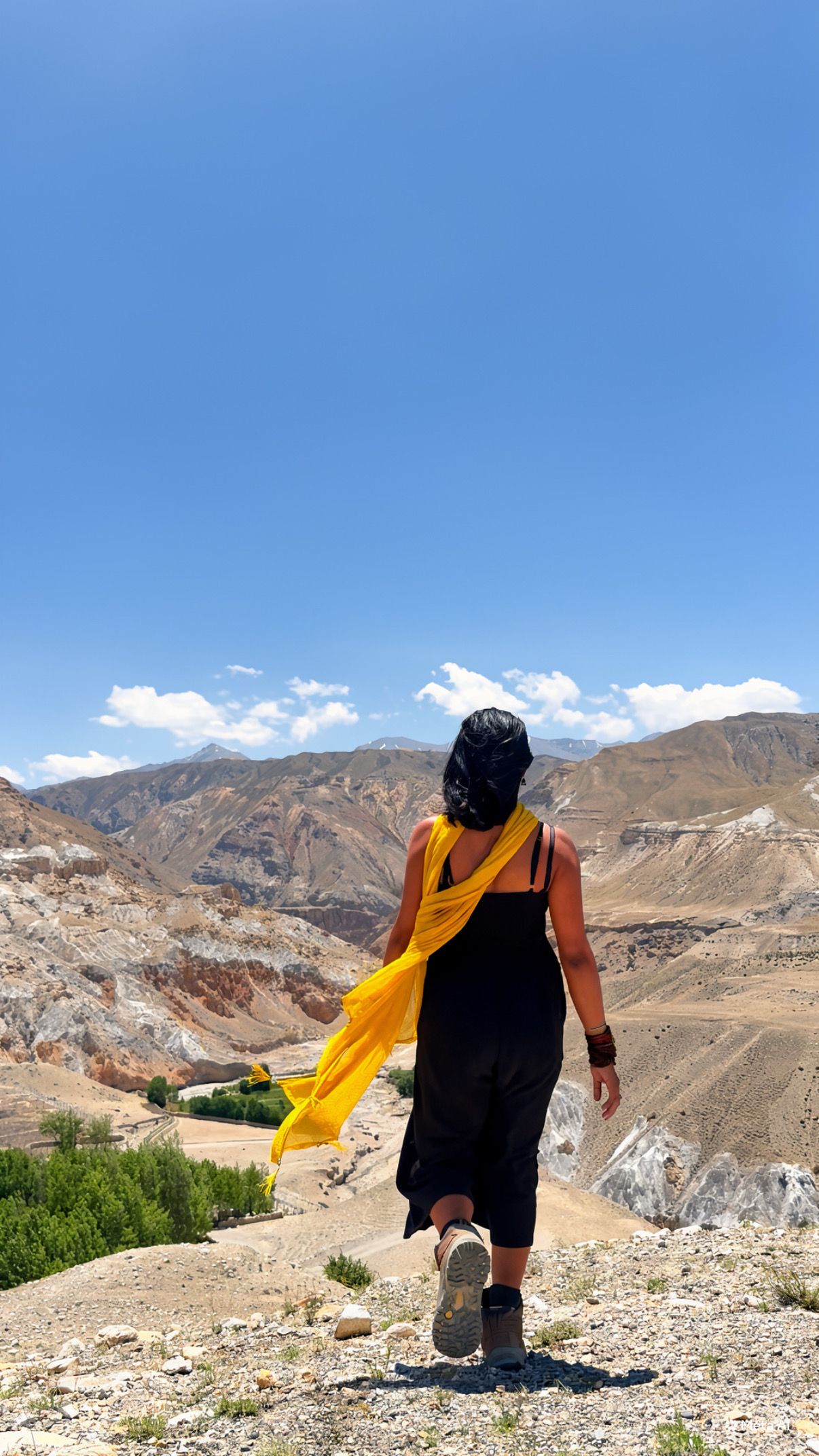
Every year, thousands of local villagers—many uneducated and completely unaware of modern "yoga studios"—embark on brutal, steep mountain ascents (Ukhalo) to high-altitude sacred shrines like Gosaikunda, Muktinath, or Pathibhara.
  [The Brutal Mountain Ascent]
                │
                ▼
  [Forced Rhythmic Breathing]  <─── (The Churning of Vayu)
                │
                ▼
  [Radiating Internal Core Heat] <─── (The Mystic Fire of Agni)
                │
                ▼
  [Spiritual Ecstasy at Peak]   <─── (Living Rig Vedic Yoga)
As these villagers carry heavy loads up near-vertical trails, their physiology naturally takes over. The thin alpine air forces their lungs to gasp and "churn" rhythmically with their heavy footsteps. The sheer physical friction ignites a powerful internal furnace in the center of their chests, keeping their vital organs warm against the freezing mountain temperatures.
They are executing highest-tier yoga out of pure survival. They are the living embodiment of the Keshin Hymn. Their physical exhaustion is the fuel, their devotion is the intent, and the burning warmth in their hearts is the mystic fire of Agni. They prove that authentic yoga belongs to the earth and the common people, not the elites. The journey itself forces the yoga out of them.
The ultimate realization of the ancient sages was radical: You do not need to wait for a mountain to ignite the fire. You can turn your own body into the pilgrimage site.
Later texts like the Siva Samhita mapped the entire sacred geography of the earth directly onto the human spine. Your spine is Mount Meru (the cosmic mountain). The energy channels running left and right (Ida and Pingala) are the sacred rivers Ganga and Yamuna. The ultimate holy destination is the crown of your head.
You can run this rigorous Vedic operating system through any activity you perform throughout your day:
[Modern Day Stress] ──► Churn the Breath ──► Visualize the mystic fire in the heart ──► Offer stress to fire & Burn the Poison
When you step onto a mat, stop treating the postures as static stretches. View each challenging pose as a steep mountain ridge. Engage deep, frictional throat breathing (Ujjayi) to intentionally churn the wind in your lungs. Let that breath friction stoke a radiant warmth in your chest, using the physical discomfort to burn away your mental ego.
When walking, running errands, or performing heavy manual labor, consciously sync your footsteps to your respiration. Feel your core temperature rise and recognize it not as mere sweat or wamth, but as Tapas—the internal mystic heart fire consuming your fatigue and purifying your focus.
The modern world constantly throws "poison" at you: stress, anxiety, digital chaos, and negative energy. Instead of swallowing this poison and letting it sicken you, or running away from it, face it directly like Rudra and the long-haired yogis. Keep your spine straight and immovable (Asana), pull the stress down into the roaring fire of your heart through deep breathing, and let your inner presence dissolve the chaos.
Authentic yoga is the deep realization that the world is not your enemy. The steep hill, the heavy load, the difficult posture, and the bitter cold are not obstacles to your practice - they are the practice.
You do not do yoga to prepare for the journey of life. The journey of life is the crucible that forces the yoga out of you.
When you strip away the modern commercial filters and tap into the ancient pilgrimage roots of the Rig Veda, you stop looking for a sanctuary to escape to. You realize that your heart houses an un-flickering, cosmic flame that cannot be put out. Every breath is a bellows, every movement is a ritual, and every single step you take on this earth is a sacred ascent.
If you are ready to move beyond the domesticated studio and experience the raw roots of this practice, join me on a Customized Himalayan Pilgrimage Yoga Retreat in Nepal.
Together, we will walk the trails, churn the breath, and learn pilgrimage yoga in the very ground where it was discovered. This isn't a vacation, it’s an initiation into an ancient Rig Vedic Yogic wisdom that you will carry back home to integrate into your daily life.
Tell me what you're looking for and we'll match you with the perfect programme in the Himalayas.
When we step onto our yoga mats, we often talk about finding balance, tapping into our intuition, and flowing with the b...
Imagine your awareness and energy is like a bucket filled with water. When the bucket is steady, the water naturally...
Have you burnt in your Inner fire? - by Shama (Guide of Women's Inner Fire Yoga) I got down to cooking my lun...